Dallas, Texas
News of the WorldDallas, Texas, is more than a stop on Jefferson Kyle Kidd’s journey: it is where the work he has traveled to do becomes entangled with the danger he is trying to keep from the girl in his care. Its busy streets, livery stable, hotel, theater, and printing establishment briefly offer the practical infrastructure of a town. But after Almay confronts Kidd there and asks how much he wants for the girl, Dallas becomes the place from which the two must flee.
Arrival in a noisy town
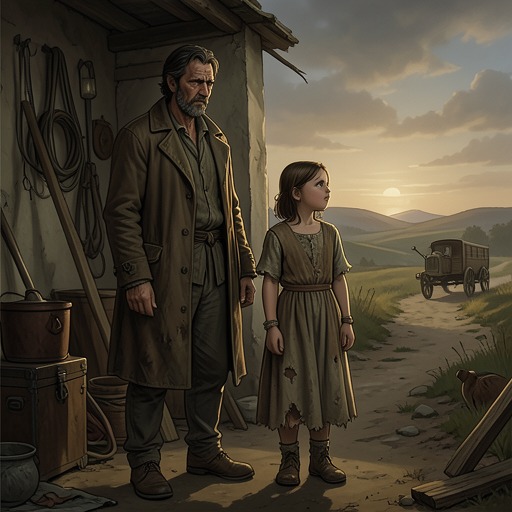
After crossing Clear Creek and Denton Creek, Kidd and the girl reached Dallas two days later, at about four on a chilly afternoon. The town seemed small, but it was markedly different from the road: several buildings rose two stories, built of brick and stone, and the streets brought unfamiliar bustle into close range. The girl, already subdued and frightened, was stunned by the wagons and noise. She jumped into the rear of the wagon and pressed herself against the seatback, between a flour keg and Kidd’s carpetbag.
They entered by the north road, passing blacksmith shops whose broad, shed-roofed interiors were lit scarlet. The shops were crowded with men and horses; tobacco smoke hung in the air while metalwork turned out the bolts and fittings that held everyday things together. The girl watched the shops apprehensively. Kidd, by contrast, was glad to see them: Dallas meant an opportunity to replace a damaged tire rim. His immediate plans were practical, beginning with asking the price of the rim and the labor to fit it.
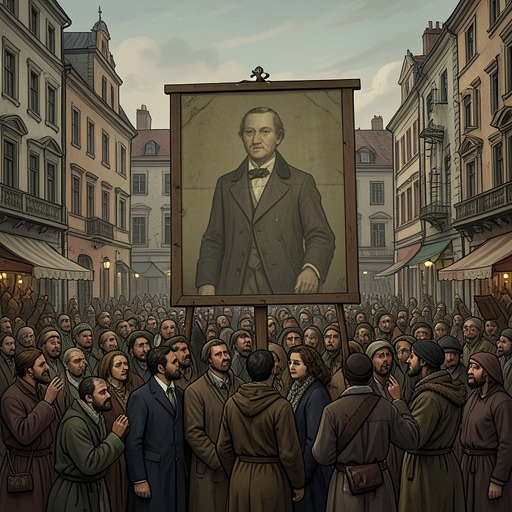
The wagon continued down Trinity Street, among men in tight-fitting clothes and women whose dresses were built up with cloth and whalebone. The girl also watched two Black women carrying shopping baskets with alarmed hens’ heads protruding from them. This street-level encounter gives Dallas its particular texture: to the girl, town life is a succession of startling sights; to Kidd, it is also a place where errands, work, and travel can briefly be organized.
Stable, lodging, and public work
At Gannet’s livery stable yard, Kidd stepped down and the stableman took hold of the roan mare’s bridle. The horse was weary, but the stableman reacted as if she might charge through the back of the yard. Kidd warned him that she was close to going wild. The arrival thus ends not in quiet rest but in the management of animals and equipment, the immediate business of keeping the journey moving.
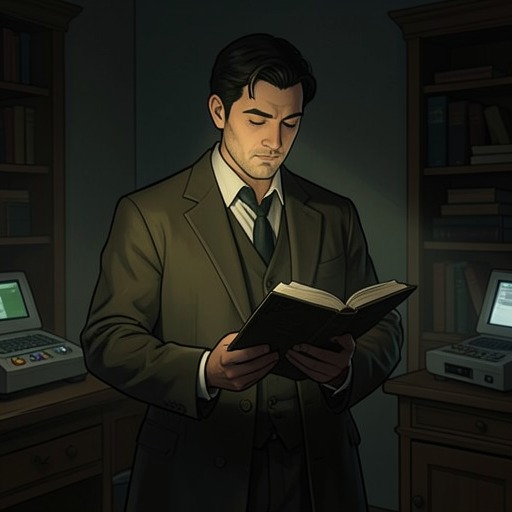
Kidd left his traveling clothes with Mrs. Gannet, then returned to the street with his portfolio of newspapers under his arm. He secured two rooms in a hotel on Stemmons Ferry Road, a balloon-frame building with thin walls and flowered grain sacks for curtains. He did not yet know how much money his readings would earn. Even so, he paid fifty cents for a bath, a price he considered outrageous, sat in the hot water for fifteen minutes, and shaved. The brief routine marks a pause in travel, but also the uncertainty beneath it: he has paid for a room and a bath before knowing what the evening’s work will bring.
He arranged that work at the Broadway Playhouse, finding its proprietor taking an early drink at the Bluebonnet Saloon. Kidd engaged the small theater for that night and wrote down the agreement, getting the proprietor to sign it in case he became too drunk to remember. The signed note turns a potentially unreliable conversation into a practical commitment. Kidd’s newspaper readings depend not only on what he carries but on securing a venue and making the arrangement hold.
He also visited Thurber’s News and Printing Establishment on Trinity Street. The smell of ink and the noise of the press drew him into a working print shop: a Chandler and Price hand-fed platen press was slowly producing announcements or advertisements, surrounded by type, bindery equipment, and a perforating machine. A sign on the wall announced the place as a printing office. The scene links Kidd’s traveling portfolio to the local machinery of print: his public readings bring newspapers to an audience, while the shop produces printed matter through the steady labor of press and type.
A threat within the town
Dallas’s public spaces do not keep danger at a distance. Almay, whom Kidd recognizes as having followed him from Wichita Falls and possibly seen him at Spanish Fort, says he has business in various places and asks how much Kidd wants for the girl. Kidd stops, stands utterly still, and understands that his earlier assumption—that nobody wanted her—was wrong. Almay makes the request a threat as well as a proposed purchase: he says that the Army does not patrol these roads as it does farther north and that he could simply take her on the road.
The confrontation changes the meaning of Kidd’s stay. The hotel, theater, and printing establishment had offered places to sleep and work; now he must consider how Almay’s party might use the roads around town to catch them. When Kidd leaves, he sees Almay and his Caddo companions heading north up Trinity Street, away from the hotel on Stemmons Ferry Road. He does not treat their departure as reassurance. Instead, he moves quickly to prepare the wagon and leave.
Departure by a false route
At Gannet’s livery, Kidd harnesses the mare, backs her into the shafts, settles the collar, fastens the trace chains, and turns the wagon outward. He changes clothes quickly, throws his newspaper portfolio and bag of coins into the wagon, and wraps the remains of supper in the frying pan. He gathers his formal black reading clothes and coat, tends to the horse tied behind, and leaves a tin pail for the stableman to return to the cookshop. These details show the abrupt conversion of a working stop into an escape: even the evening’s reading clothes and the remnants of supper must be dealt with as the pair prepares to go.
Kidd says he will fetch Mrs. Gannet and settle the account in half an hour. The stableman, half asleep in an empty stall with an empty bottle nearby, complains about the late-night hurry before falling back into the straw. Kidd’s hurried departure is therefore carried out amid the ordinary disorder of the stable, without a reliable ally there to manage the details for him.
When Kidd and the girl pull into the nighttime streets, she stands holding the lantern. They take the Waxahachie Road south, not the Meridian Road southwest, because Kidd expects Almay and his companions to anticipate the latter route. His plan is to turn west later and rejoin Meridian Road, hoping that the absence of fresh tracks there will send the pursuers searching elsewhere and win them three or four hours. Dallas’s roads become part of the strategy: the town is not simply left behind but used as the starting point for a deliberate misdirection.
They trot into the Brownwood Hills, intending to reach the ravined country around the Brazos River before daylight and watch for pursuit from high ground. Under a three-quarter moon and a sky clearing after rain, Kidd tries to put as many miles as possible between the wagon and Almay’s party. The shift from the lit workshops and public streets to an indistinct road at night gives Dallas its decisive narrative role. It is both the first town to make Kidd’s itinerant work possible and the place where the demand for the girl makes continued travel together an immediate danger.